Japanese Paintings
Samantabhadra
- MediumPainting
- OriginalWatercolour Painting
- RefPID 236
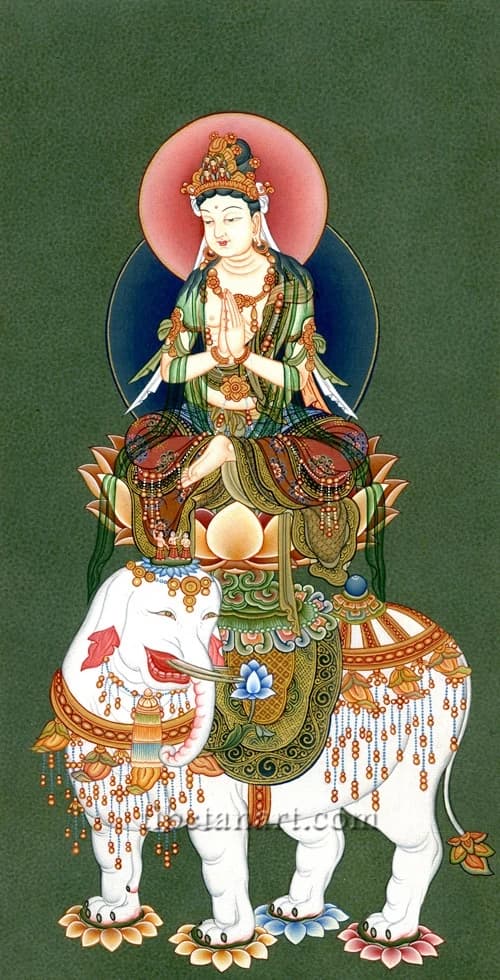
SOLD: Samantabhadra, the ‘all good’, is known in Japan as Fugen Bosatsu, and in China as Pu Hsien, and along with the Bodhisattvas Avalokiteshvara (compassion) and Manjushri (wisdom) he represents the ‘power’ aspect in the trinity of the Buddha’s enlightened qualities in these traditions. As the Bodhisattva of ‘universal goodness’ Samantabhadra is personified as the perfect practitioner in the Lotus Sutra, the Threefold Lotus Sutra and the Avatamsaka Sutra, where he made ten great vows that serve as guides to illuminate the Bodhisattva Path. Along with Manjushri he is often depicted flanking either Shakyamuni Buddha or Vairocana Buddha.
Samantabhadra’s vehicle is Airavata, the miraculous six-tusked white elephant of Indra, which walks above the ground upon lotus flowers. This elephant is adorned with all manner of divine jewels, an embroidered silk saddlecloth, an eight-spoke golden wheel with a central gem that rests upon his rump, and three young goddesses that dance upon the lotus that crowns his head. A multicoloured lotus rests upon the elephant’s saddlecloth, and above this are clouds that bear the open pink lotus upon which Samantabhadra sits in sattva-paryanka posture.
Samantabhadra is youthful, peaceful, beautiful and radiant white in colour. He is adorned with all manner of jeweled ornaments and divine silk garments, and his hands are palms-folded in front of his heart in the anjali-mudra of adoration. His black hair is piled up into a topknot with loose strands hanging freely about his shoulders, and his golden crown is adorned with the small images of the Buddhas of the Five Enlightened Families.
© text by Robert Beer